Creating Multi-Parental Populations
This example will provide a walkthrough for how to create populations similar to the MAGIC protocol. In this example we are not using inbred lines so it is a slight misnomer to call it the MAGIC protocol; however, when I initially wrote the code I was not aware of the difference. I will change it before launch.
import simuOpt
simuOpt.setOptions(alleleType='short', quiet=True)
import simuPOP as sim
import numpy as np, pandas as pd
from saegus import breed, parse
np.set_printoptions(suppress=True, precision=3)
Reload the example population.
example_pop = sim.loadPopulation('example_pop.pop')
example_pop.addInfoFields(['ind_id', 'mother_id', 'father_id'])
sim.tagID(example_pop)
Load up the recombination map for this example
tf = parse.RecomRates()
recom_map = tf.parse_recombination_rates('example_genetic_map.txt')
Example Multi-Parental Population
In these examples the term multi-parental population implies that a group of founders are mated in pairs to create an F1 population. The sub-populations created from the pairs of offspring are then mated pairwise. This process repeats until there is only a single sub-population. It is best explained with a picture. Suppose you have individuals A, B, C, D, E, F, G, H
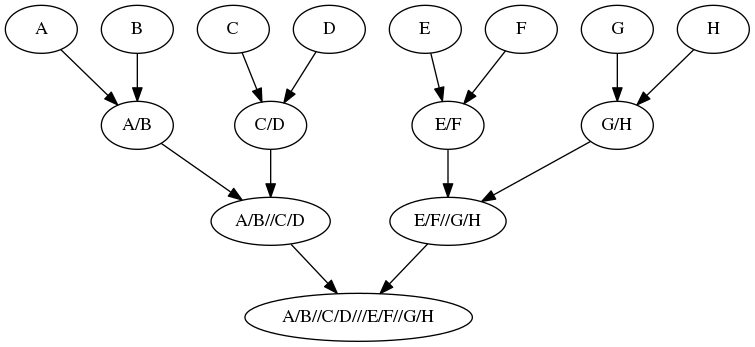
Multi-Parental Breeding Protocol
Through the course of development I developed several ways to specify creating
a multi-parental multi-generational mating scenario. Each way has it’s own
benefits. Some functions allow for more fine-grained control of the specific
crosses. There are functions that can be used with single replicates or multiple
replicates. Each has its own quirks and assumptions because of the way
simuPOP requires the input. Here we will use the most recent and probably
best incarnation of creating multi-parental populations.
Creating the F1
The first step is unique. In this case we specify pairs of individuals. The
steps that follow this one operate on entire sub-populations. We will create an
F1 population from 8 members from example_pop.
Note
We specify individuals using the ind_id information field so it must be set.
founders = [[1, 2], [3, 4], [5, 6], [7,8]]
offspring_per_pair = 500
magic = breed.MAGIC(example_pop, founders, recom_map)
example_pop.popSize() # prior to mating
# 105
magic.generate_f_one(founders, offspring_per_pair)
example_pop.popSize() # after mating
# 2000
The new population size is 2000. We provided four pairs in founders and
we specified 500 offspring_per_pair. The result is 500 individuals from
each of the four crosses for a total of 2,000 individuals. We should check
the pedigree to be sure.
Quick Check of the F1 Pedigree
We should have 500 offspring from individuals 1 and 2, 500 from
individuals 3 and 4, 500 from 5 and 6 and 500 from
7 and 8.
pedigrees = {}
pedigree = np.array((example_pop.indInfo('ind_id'),
                     example_pop.indInfo('mother_id'),
                     example_pop.indInfo('father_id'))).T
pedigrees[0] = pedigree
print(pedigree[:500])
# [[ 106.,    1.,    2.],
#  [ 107.,    1.,    2.],
#  [ 108.,    1.,    2.],
#  ...,
#  [ 603.,    1.,    2.],
#  [ 604.,    1.,    2.],
#  [ 605.,    1.,    2.]]
print(pedigree[500:1000])
# [[  606.,     3.,     4.],
#  [  607.,     3.,     4.],
#  [  608.,     3.,     4.],
#  ...,
#  [ 1103.,     3.,     4.],
#  [ 1104.,     3.,     4.],
#  [ 1105.,     3.,     4.]]
print(pedigree[1000:1500])
# [[ 1106.,     5.,     6.],
#  [ 1107.,     5.,     6.],
#  [ 1108.,     5.,     6.],
#  ...,
#  [ 1603.,     5.,     6.],
#  [ 1604.,     5.,     6.],
#  [ 1605.,     5.,     6.]])
print(pedigree[1500:2000])
# [[ 1606.,     7.,     8.],
#  [ 1607.,     7.,     8.],
#  [ 1608.,     7.,     8.],
#  ...,
#  [ 2103.,     7.,     8.],
#  [ 2104.,     7.,     8.],
#  [ 2105.,     7.,     8.]]
Single Replicate Population: MAGIC and Random Cross
Now that we have the F1 from the previous step we can continue down
the MAGIC protocol. The approach here is to create arrays of ind_id to
determine the mating events. Assuming that we have 4 sub-populations with 500
individuals each: we choose 1000 individuals from sub-population 1 to mate with
1000 individuals with sub-population 2. Choose 1000 individuals from
sub-population 3 to mate with 1000 individuals from sub-population 4. The
output is a tuple of arrays so we can “unzip” the return value into different
variables.
Note
Sampling is done with replacement. This method ignores sex.
converging_random_cross()¶random_cross = breed.RandomCross(example_pop, 4, 500)
mothers, fathers = random_cross.converging_random_cross()
print(mothers)
# [ 167. 382. 424. ..., 1270. 1109. 1230.]
print(fathers)
# [ 936. 629. 1095. ..., 2020. 1722. 1773.]
In this case individual 167 will be mated with individual 936, 382
with 629 so on and so forth.
second_order_chooser = breed.SecondOrderPairIDChooser(mothers, fathers)
example_pop.evolve(
    matingScheme=sim.HomoMating(
        sim.PyParentsChooser(second_order_chooser.snd_ord_id_pairs),
        sim.OffspringGenerator(
            ops=[sim.IdTagger(), sim.PedigreeTagger(), sim.Recombinator(rates=recom_map)],
                numOffspring=1),
        subPopSize=2000
    ),
    gen=1
)
# 1
Checking the Pedigree After First Random Cross
As before we will check the pedigree to make sure our custom parent chooser function is working properly.
pedigree = np.array((example_pop.indInfo('ind_id'),
                     example_pop.indInfo('mother_id'),
                     example_pop.indInfo('father_id'))).T
pedigrees[1] = pedigree
pedigree
# [[ 2106.,   167.,   936.],
#  [ 2107.,   382.,   629.],
#  [ 2108.,   424.,  1095.],
#  ...,
#  [ 4103.,  1270.,  2020.],
#  [ 4104.,  1109.,  1722.],
#  [ 4105.,  1230.,  1773.]]
It seems to be correctly matching parents together based upon ID fields. A
more exhaustive verification could be done by comparing the mother IDs with
the father IDs and seeing if they match in order as the mothers and
fathers arrays.
Final Random Cross
If we repeat the same process one more time the population will be ‘converged’. In other words the genomes of all of the original founders will be representing by a single admixed population.
final_random_cross = breed.RandomCross(example_pop, 2, 1000)
mothers, fathers = final_random_cross.converging_random_cross()
print(mothers)
# [ 2217.,  2473.,  2160., ...,  2179.,  2963.,  2836.]
print(fathers)
# [ 3951.,  4025.,  3355., ...,  3580.,  3464.,  4084.]
Given the final mate choices we repeat the same evolutionary process.
final_chooser = breed.SecondOrderPairIDChooser(mothers, fathers)
example_pop.evolve(
    matingScheme=sim.HomoMating(
        sim.PyParentsChooser(final_chooser.snd_ord_id_pairs),
        sim.OffspringGenerator(
            ops=[sim.IdTagger(), sim.PedigreeTagger(), sim.Recombinator(rates=recom_map)],
                numOffspring=1),
        subPopSize=2000
    ),
    gen=1
)
# 1
Final Pedigree Check
Let’s compare the final pedigree the same way as the others.
pedigree = np.array((example_pop.indInfo('ind_id'),
                     example_pop.indInfo('mother_id'),
                     example_pop.indInfo('father_id'))).T
pedigrees[2] = pedigree
print(pedigree)
# [[ 4106.  2217.  3951.]
#  [ 4107.  2473.  4025.]
#  [ 4108.  2160.  3355.]
#  ...,
#  [ 6103.  2179.  3580.]
#  [ 6104.  2963.  3464.]
#  [ 6105.  2836.  4084.]]
Seems to match up. Now we have the pedigree of the entire breeding process.
The dictionary pedigrees has the first, second and third generation in case
we want to analyze the pedigree.